

About
Radware Ltd. is a global cybersecurity and application delivery company serving more than 12,500 enterprise and service provider customers worldwide.
Goal
As enterprises rapidly adopted AI agents, Radware identified an opportunity to build a purpose-built Agentic AI Protection Platform—the first of its kind—to protect enterprise environments from a new class of threats. Radware asked Cloudride to design and deliver an enterprise-grade AWS platform on Amazon EKS and Amazon Bedrock. The goal was to profile agent behavior, discover unauthorized agents and MCP tools, and detect and prevent agent-specific attacks in real time at a scale of over 1,000 requests per second with ultra-low latency (under 100 ms off-path, under 200 ms in-path) and under 5% false positives.
Challenges
Traditional security tools like Web Application Firewalls (WAFs) and API gateways were designed for standard HTTP request/response patterns and cannot see or interpret agentic AI workflows. As a result, enterprises faced severe security gaps without any established reference architectures for this new category:
- Agent Behavior Hijacking: Adversaries manipulate an AI agent’s decision-making processes.
- Tool Misuse & Exploitation: Agents are tricked into calling tools that execute harmful operations using the agent’s own privileges.
- Memory Poisoning: An agent’s long-term memory or context is corrupted to influence future behavior over time.
- Insecure Inter-Agent Communication: Direct messaging between distinct AI agents occurs without security inspection.
- Rogue Agents & Zero Visibility: Organizations had no inventory, discovery mechanisms, or catalog to monitor unauthorized AI agents operating inside their infrastructure.
- Strict Performance & Latency Bar: Any security solution placed in the traffic path of enterprise AI agents had to evaluate foundation model reasoning without introducing unacceptable latency or false positives.
Solution
Cloudride designed and delivered the AWS platform that powers Radware’s Agentic AI Protection Platform. Combining Radware’s proprietary detection engine with Amazon Bedrock foundation models on a Kubernetes-native architecture on Amazon EKS, the platform delivers both Generative AI reasoning and Agentic AI discovery and protection capabilities.
Delivered via a structured 12-week proof of concept (POC) across four phases with formal acceptance gates, the solution successfully passed rigorous load testing and received customer sign-off on June 21, 2026. The initial product workloads—Dispatcher and MCP Protection (MCPP)—entered early-stage production in September/October 2026 in the Radware Cloud account.
Technical Solution
The underlying infrastructure was built in us-east-1 and is expanding across a multi-region target footprint:
- Compute & Infrastructure Layer:
- Amazon EKS (Kubernetes 1.28): Multi-AZ deployment utilizing 25 Amazon EC2 m5.4xlarge worker nodes (400 vCPUs, 1,600 GiB RAM in total) covered by a Compute Savings Plan to support long-running, stateful, and latency-sensitive inspection engines that do not fit a serverless model.
- Platform services on EKS include ClickHouse for time-series analytics, Redis for low-latency session state and agent profiles, Kafka/NATS for event streaming, an analytics dashboard, and an audit trail.
- Generative & Agentic AI Layer:
- Multi-Model Amazon Bedrock Architecture: Claude Sonnet performs complex threat reasoning over multi-step attack chains, while Amazon Nova performs high-volume pattern matching.
- Pod-Level IAM Security: IAM Roles for Service Accounts (IRSA) enforce strict least-privilege access to Amazon Bedrock with dedicated roles for each model family.
- Agent & MCP Security Pipeline: Automatically discovers home-grown agents (Python, Go, Node.js) and implements a four-stage protection pipeline covering registration/authentication, tool discovery, CVE protection, and DDoS mitigation for Model Context Protocol (MCP) tools.
- Dual Integration Modes: Supports API Off-Path mode (under 100 ms added latency) and In-Path Proxy mode (under 200 ms added latency), routing low-confidence detections to a human-in-the-loop analyst queue while reserving automatic blocking for high-confidence threats.
- Recorded AWS billing reflects Amazon Bedrock AgentCore usage (~$144 recorded cost from Jan–Sep 2026 across four accounts) alongside active Bedrock billing in both Radware AWS Organizations (Radware Cloud & Radware R&D).
- Storage, Networking & Security:
- Amazon EFS (1,500 GB, AES-256): Shared persistent storage for versioned CVE signature packs.
- Amazon ECR: Stores container images.
- Network & Granular Controls: Amazon VPC CNI with pod-level security groups, Kubernetes network policies, and Application Load Balancer ingress.
- Operations & Governance: AWS Secrets Manager, AWS KMS encryption, AWS CloudTrail, and Amazon CloudWatch Container Insights featuring ~20 custom alarms and 3 operational dashboards.
Results
Measured and verified during POC load testing (signed off June 21, 2026):
- High Throughput: Sustained over 1,000 requests per second on the 25-node EKS cluster.
- Ultra-Low Added Latency: Under 100 ms in API off-path mode and under 200 ms (p95) in in-path proxy mode.
- High Precision: Achieved an overall false positive rate of under 5%.
- 100% Threat Vector Coverage: Successfully detected and prevented all five agentic attack vectors (behavior hijacking, tool misuse, memory poisoning, insecure inter-agent communication, and rogue agents).
- Complete Visibility: Delivered full agent discovery and tool cataloging across enterprise environments, eliminating zero-visibility risks.
- Production Validation: Dispatcher and MCP Protection workloads successfully entered production in September/October 2026.
Moving Forward
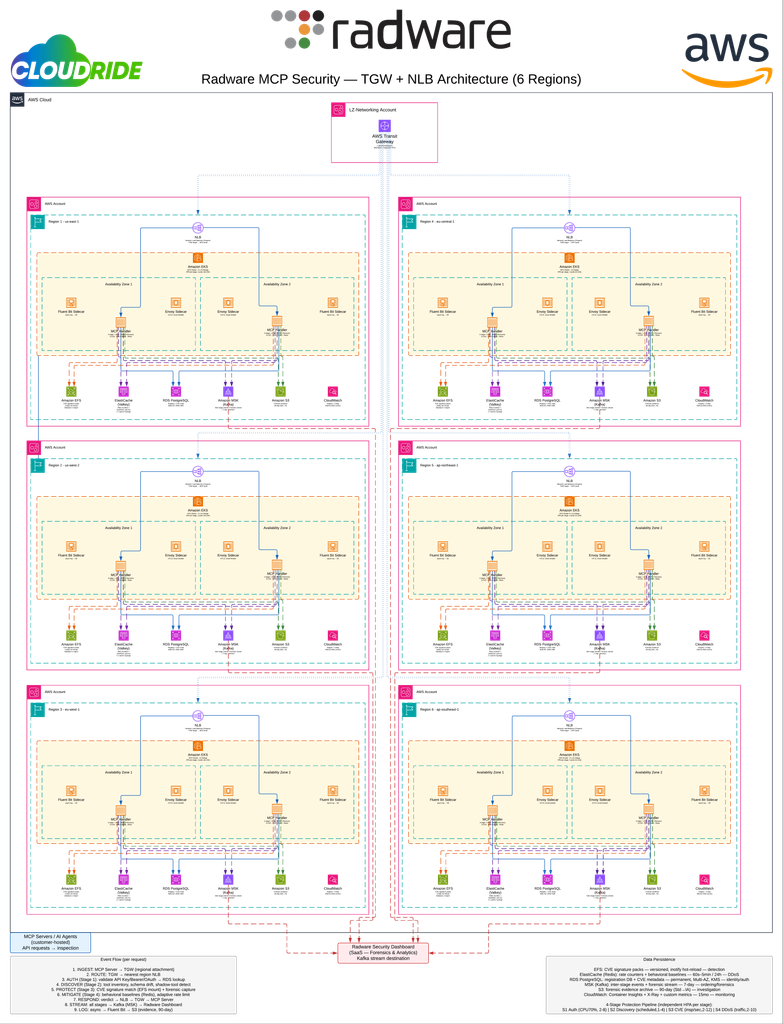
Following the successful POC sign-off and initial deployment, Cloudride continues its engagement with Radware under the MAP Mobilize statement of work (running November 2, 2026 to May 2, 2027). This next phase expands the platform’s production footprint across six AWS Regions (us-east-1, us-west-2, eu-central-1, eu-west-1, ap-northeast-1, ap-southeast-1) utilizing AWS Transit Gateway, Network Load Balancers, and regional Amazon EKS clusters with managed data services.
- Implementation Period: January 2026 – June 2026 (POC Sign-off)
- Use Case: AI Agent Security
- AI Category: Generative AI & Agentic AI
- AWS Region: us-east-1 (Expanding to 6 AWS Regions)
- Production Status: In Production (Early Stage)